


Poker is an incredibly engaging card game that has become a staple in various cultures all around the world. In any game of poker, a player’s strategy, psychological aptitude, and sheer luck all come into play. Whether you have just started playing poker or wish to refine your playing skills, you can use a poker cheat sheet to facilitate better decision-making. This article will explain some key poker strategies, hand ranks, and other useful tips that enhance your gameplay and take you up the levels in the game.
Understanding Poker Hand Rankings
Before we get into strategies, it is essential to understand the poker hands ranking. Such as which hand is able to beat which other hand. There are poker hand rankings and the betting should be done depending on how stronger the hand is compared to the other. In this case, here is a guide to what the hands are, ordered from the one with the highest ranking to the one with the lowest:

- Royal Flush: A, K, Q, J, 10, all in the same suit (e.g., all hearts).
- Straight Flush: Five consecutive cards of the same suit (e.g., 9, 8, 7, 6, 5 of spades).
- Four of a Kind: Four cards of the same rank (e.g., four queens).
- Full House: Three cards of one rank and two cards of another rank (e.g., three 10s and two 6s).
- Flush: Five cards of the same suit, not in consecutive order.
- Straight: Five consecutive cards, not all in the same suit.
- Three of a Kind: Three cards of the same rank.
- Two Pair: Two cards of one rank and two cards of another rank.
- One Pair: Two cards of the same rank.
- High Card: If no one has a hand that fits the categories above, the player with the highest card wins.
Basic Poker Terminology You Should Know
Familiarity with basic poker vocabulary will greatly enhance your game play as well as help you keep track of the game. Here are some important terms that you should know:
- Blinds: Forced bets by the two players left of the dealer.
- Call: Matching the current bet made by another player.
- Raise: Increasing the bet after another player has made a bet.
- Fold: Discarding your hand and opting out of the current round.
- Flop: The first three community cards dealt face-up.
- Turn: The fourth community card dealt face-up.
- River: The fifth and final community card dealt face-up.
- Pot: The total amount of money or chips wagered during a hand.
Starting Hand Guide: When to Play or Fold
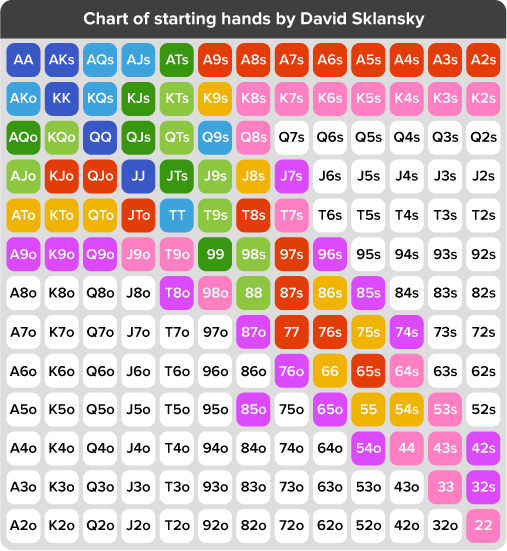
Premium Hands (Raise or Call):
- Pocket Aces (AA)
- Pocket Kings (KK)
- Pocket Queens (QQ)
- Ace-King Suited (AKs)
These hands should generally be raised or called, as they are very strong.
- Good Hands (Play with Caution):
- Pocket Jacks (JJ)
- Ace-Queen Suited (AQs)
- King-Queen Suited (KQs)
- Ace-Jack Suited (AJs)
These hands are solid but can be tricky. If someone raises significantly, proceed with caution.
- Hands to Fold (Low Probability):
- Low unsuited cards (e.g., 7-2 offsuit, 9-3 offsuit)
- Offsuit face cards without good kickers (e.g., K-10 offsuit)
Hands like these have a low probability of winning and can be easily dominated by stronger cards.
Poker Betting Strategy: Know When to Bet, Raise, or Fold
1. Bluffing
Bluffing is among the common poker tactics employed by many players, however, it is not advisable to use bluffing too frequently. Attempt a bluff when it’s your turn to act, and the players ahead of you did something passive like just called or checked rather than raised the pot. After all, do not take this option too often, as seasoned players will outsmart you sooner or later.
2. Value Betting
Valuerebetting is making the most of the situation when you have a very strong hand and want to take as much money as possible from your opponents.
3. C-Betting (Continuation Betting)
A C-bet is also an option if you have raised pre-flop and missed the flop; raising still gives you the option of continuing to bet to show that you are strong. This means they are forced to lose their weaker hands. Be careful when employing this technique as over-use can lead to losses when opponents are able to seam together what you are doing.
4. Position Advantage
Your seat at the table has its significance. If you have an early position (to act first for example), you need to be conservative as many players still have an option of playing. If there is a late position (the last person to play), one may play aggressive as now he knows the hands of all other players.
Reading Your Opponents: The Power of Observation
- Betting Patterns: It is important to keep track of how your rival plays the game; for instance, does he/she always make a bet when holding a good hand or bluff at a given scenario? Such patterns should also be documented.
- Physical Tells: It is not uncommon in some players to notice specific physical “tells” which could be for example hands that are shaking when trying to bluff or suddenly shifting in movement when strong with a hand.
- Timing: A player who has taken a lot of time to play actions may be indecisive about their hand or even attempting to perform a bluff. Actions that are made too fast are signs of confidence or they are moves that have already been planned out.
Key Tips for Poker Success
The following are some further considerations to help you reach the desired poker level:
- Caution and Patience: There is no need to play every hand and get caught up in the feel of the game. It is best to fold often especially when your hand is not strong.
- Strategy Modification: You have to modify your strategy depending on how aggressive or passive the opponent is. You need to adjust your game mtode to suit them.
- Don’t Tilt After Losing: Don’t try to panic-bet all over the place if you have already lost a few hands. Take a deep breath and be disciplined to stick to your game strategy.
- Bankroll Plan: Determine in advance the amount you can realistically afford to lose and use those limits on the betting. With proper bankroll management, you can play for ages.
Conclusion
Poker is a lively game that combines strategy, psychology, and probabilities. Learning hand rankings, basic betting strategies, and the poker language can allow you to make the most of your opportunities at the poker table. arisantoto.net remember that patience and observing other players’ behavior is as vital as the cards in your hand. So the next time you sit down at a poker game, refer to this cheat sheet and be able to make better choices and enjoy the excitement of the game.